Freshlyground Reborn; Mbali Makhoba Leads
The rebirth of Freshlyground is less a comeback than a cultural reset, one that places 19-year-old Mbali Makhoba at the center of a new Afropop chapter shaped by legacy, youth and renewal.
For nearly two decades, the band’s identity was inseparable from Zolani Mahola, whose voice carried the spirit of post-apartheid optimism and pan-African fusion into global consciousness. Songs like Nomvula became cultural touchstones, blending folk, jazz and township rhythms into a sound embraced across African cities and diaspora communities hungry for authenticity.
Mahola’s departure in 2019 closed that era with intention. After 17 years, she stepped away to pursue a solo path rooted in heritage, spirituality and personal storytelling, now performing as The One Who Sings alongside her ensemble The Feminine Force. Her exit reflected a broader movement within African music where established voices break away from commercial frameworks to reconnect with indigenous identity and narrative sovereignty.
Freshlyground did not rush to fill the void. Instead, the band entered a prolonged silence, retreating for over four years in what drummer Peter Cohen described as a necessary period of healing and recalibration. For followers of Afropop, this pause became part of the story itself, reinforcing the genre’s communal ethos where transitions are absorbed, not avoided.
The arrival of Makhoba signals something fundamentally different rather than a simple replacement. Young, self-assured and musically agile, she represents a generation raised in a digitally fluid Africa where genres blur but roots remain central. Her voice carries a lighter, more elastic tone compared to Mahola’s earthy depth, allowing Freshlyground to experiment with brighter melodic textures while maintaining their signature fusion.
Band flautist Simon Attwell has described Makhoba’s presence as both fearless and grounded, a performer capable of commanding attention without overpowering the collective. That balance is critical in Afropop, where the ensemble often outweighs the individual and storytelling is shared across instruments and voices.
Makhoba herself acknowledges the weight of history but approaches it with clarity rather than imitation. She is not attempting to recreate Mahola’s imprint but to extend it, bringing her own interpretation shaped by youth culture, contemporary African soundscapes and a deep respect for the band’s roots.
The group’s reintroduction at Kirstenbosch National Botanical Garden marks more than a return to stage. It signals a reconnection with audiences who have sustained Afropop as a living, evolving form tied to identity, migration and celebration.
As new music looms in 2025 and beyond, Freshlyground’s transformation underscores a familiar rhythm in African music history. Icons emerge, depart and re-emerge in new forms, while the culture itself continues forward. In Mbali Makhoba, the band has not only found a new voice but a bridge to the future, one that keeps Afropop alive, responsive and unmistakably African.
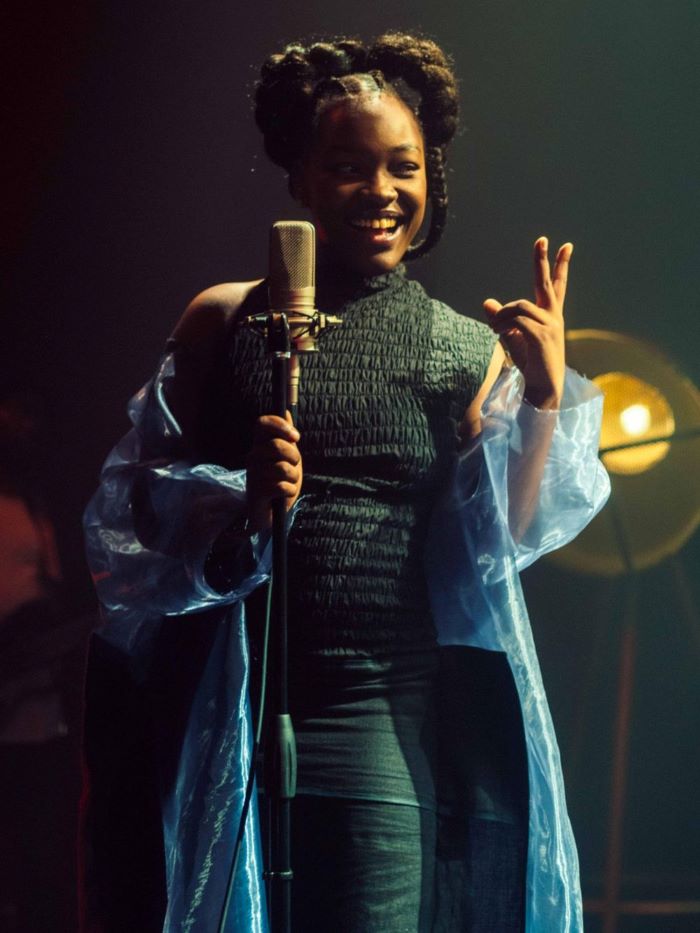
Photo – Freshlyground vocalist Mbali Makhoba preforming (© Freshlyground)