

Paris, The Funkees & the Funk
The story of The Funkees and their enduring track Akula Owu Onyeara has long been framed as a Nigerian moment. That framing is incomplete. To understand how this record moved from a postwar studio in Nigeria to dance floors and radio circuits in Europe, and eventually into global consciousness decades later, one must follow the band out of Nigeria and into London, and from there into Paris.
Formed in the aftermath of the Nigerian Civil War, The Funkees emerged from Aba with a sound that was restless and uncontained. Their music fused Igbo highlife with American funk, soul and elements of psychedelic rock. It was not designed for export in the conventional sense. It was raw, extended, rhythmically dense and linguistically rooted. When Akula Owu Onyeara was released in 1973 under EMI Nigeria, it carried the urgency of its time but lacked the infrastructure to travel far beyond its immediate environment.
That limitation began to shift when the band relocated to London in the same year. This move, often treated as a footnote, was in fact decisive. London in the early 1970s was becoming a loose but fertile meeting point for African and Caribbean musicians. It was not yet an industry in the formal sense, but it was a network in formation. Musicians performed in clubs, collaborated across national lines and recorded under improvised conditions. Within this emerging ecosystem, The Funkees were not outsiders. They were participants in a broader reconfiguration of Black Atlantic sound.
Central to this transition was the Sierra Leonean, Akie Deen, a figure whose role has been consistently underestimated. Deen was among the earliest organisers of a transnational African music circuit in London. He worked without the benefit of established distribution systems, building connections manually between artists, venues, record shops and radio programmers. His work extended beyond promotion into production and cultural brokerage. He was, in effect, an infrastructure where none existed.
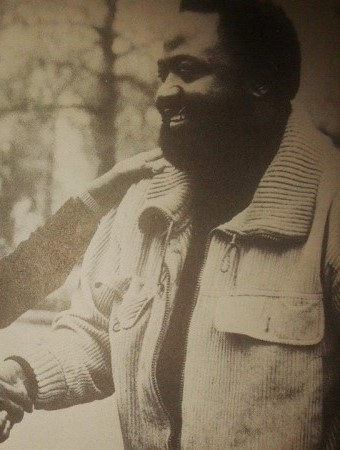
Akie Deen
Through Deen’s network, The Funkees recorded and circulated their music within a diaspora that was already mobile. Their debut album Point of No Return would later appear in France under the title Afro-Funk Music, a shift that signals more than marketing. It reflects an early recognition that African music required translation not of sound, but of context, for European audiences. Deen facilitated this movement, ensuring that records did not remain confined to London but travelled into continental Europe through both formal and informal channels.
This is where Paris enters the story, not as a passive recipient but as an active interpreter. While London provided the base, Paris offered the conditions for revaluation. By the late twentieth century, the city had developed a reputation for engaging with non-Western music on its own terms. African records were collected, archived and reintroduced into circulation with a level of care that contrasted with the more commercially driven British market.
The presence of The Funkees within European circuits during the 1970s meant that their music was already embedded in these networks long before its later rediscovery. Akula Owu Onyeara did not arrive in Paris as an obscure artefact waiting to be found. It had been carried there, directly or indirectly, through the movements of musicians, promoters and records themselves. Performances, personal exchanges and early distribution all contributed to its presence.
When European reissue culture began to take shape decades later, labels such as Soundway Records played a role in reintroducing The Funkees to a new generation. Yet this was less a discovery than a reactivation. The groundwork had already been laid in the 1970s. What changed was the framework of listening. Parisian DJs, collectors and programmers placed the track within a broader Afro-diasporic canon, where its length, texture and intensity became assets rather than obstacles.
Meanwhile, the band itself had fragmented by 1977. Members such as Jake Sollo and Harry Mosco continued to work in music, both in Europe and back in Nigeria, but the collective momentum dissipated. Some of the key figures would pass away in the decades that followed, leaving behind recordings but limited institutional memory. Nigeria, for all its creative output, lacked the archival systems to preserve and project such work internationally.
It is in this gap that Europe, and particularly Paris, assumed an unexpected role. The city did not create the music, but it contributed to its endurance. By framing The Funkees within a lineage of global sound, Parisian intermediaries transformed Akula Owu Onyeara from a regional hit into a transnational reference point. The track’s later resonance in clubs, compilations and specialist radio was built on this layered history of movement and reinterpretation.
What emerges is not a simple narrative of rediscovery, but a more complex account of circulation. The Funkees’ sojourn in Europe was neither accidental nor marginal. It was a formative period in which their music entered networks that would sustain it long after the band itself had ceased to exist. The connection to Paris was not a random romance sparked by distant admiration. It was the outcome of proximity, labour and mediation, shaped in large part by figures like Akie Deen.
To view Akula Owu Onyeara solely through its Nigerian origin is to miss the conditions that allowed it to survive and expand. Its global afterlife is inseparable from the European routes it travelled, the London scene that incubated it and the Parisian culture that reframed it. The song endures not only because it was recorded, but because it moved.
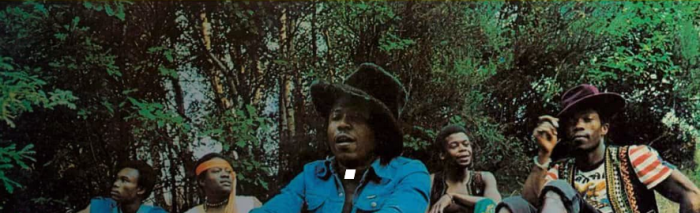
The Funkees (Band) Harry Mosco — rhythm guitar, backing vocals, gong. Mohammed Ahidjo — lead vocals, percussion. Jake N. Sollo — lead guitar, backing vocals, organ, piano. Danny Heibs — bass, backing vocals, percussion. Chyke Madu — drums, backing vocals. Sonny Akpabio — congas, backing vocals. Roli Paterson — bongos, percussion. Sunny Akpan – bongos, congas, percussion. Tony Mallett — percussion and vocals.
Photo – Album cover (©EMI Nigeria)